

Crimping terminal pins correctly is a fundamental skill in electrical assembly and wiring applications.Whether used in automotive systems,industrial equipment,or consumer electronics,properly crimped electrical terminal pins ensure stable conductivity,mechanical strength,and long-term reliability.A poor crimp can lead to signal loss,overheating,or even system failure,making technique and precision critically important.
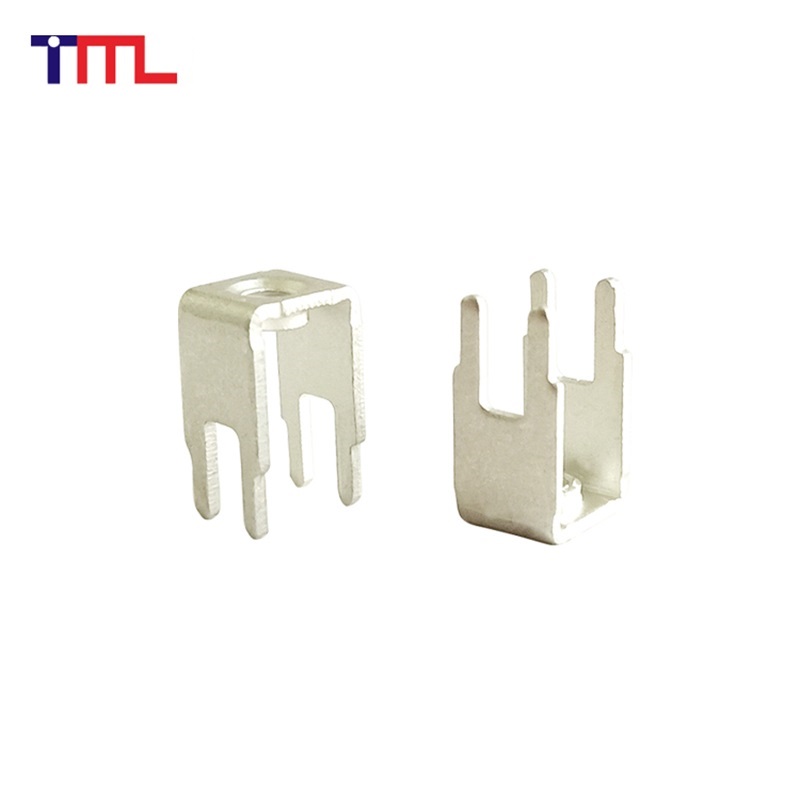
At its core,crimping is a mechanical process that joins a wire to connector pins by compressing the terminal barrel around the stripped wire strands.Unlike soldering,crimping does not require heat;instead,it relies on controlled pressure to create a gas-tight connection.When done properly,the wire and the wire terminal pins form a secure bond that resists vibration,corrosion,and electrical resistance.
The process begins with proper wire preparation.The insulation must be stripped to the correct length,exposing enough conductor to fitداخلthe terminal without leaving excess bare wire.The stripped wire is then inserted into the barrel of the terminal pins,ensuring that all strands are fully seated.Positioning is crucial at this stage,as misalignment can result in uneven compression and a weak connection.
Once the wire is in place,a suitable crimping tool is used to compress the terminal.High-quality tools are designed to match specific types of electrical terminal pins,applying consistent force to achieve the correct shape and pressure.As the tool is engaged,it deforms the metal barrel around the wire,creating a tight mechanical and electrical connection.A properly crimped joint should appear uniform,with no cracks,loose strands,or excessive deformation.
Attention to detail is essential throughout the process.Using the wrong tool or incorrect die size can damage connector pins or result in insufficient compression.Similarly,over-crimping can weaken the metal structure,while under-crimping may cause the wire to loosen over time.For this reason,professionals often perform a pull test after crimping to confirm that the wire terminal pins are securely attached.
In practical applications,the quality of the crimp directly affects system performance.Well-crimped terminal pins provide low-resistance connections that support efficient power and signal transmission.They are also more resistant to environmental factors such as vibration and temperature changes,which is why crimping is widely preferred in demanding industries.
In conclusion,mastering the correct method for crimping terminal pins is essential for achieving reliable and durable electrical connections.By focusing on proper wire preparation,using the right tools,and ensuring accurate technique,you can maximize the performance and lifespan of electrical terminal pins,connector pins,and wire terminal pins in any application.